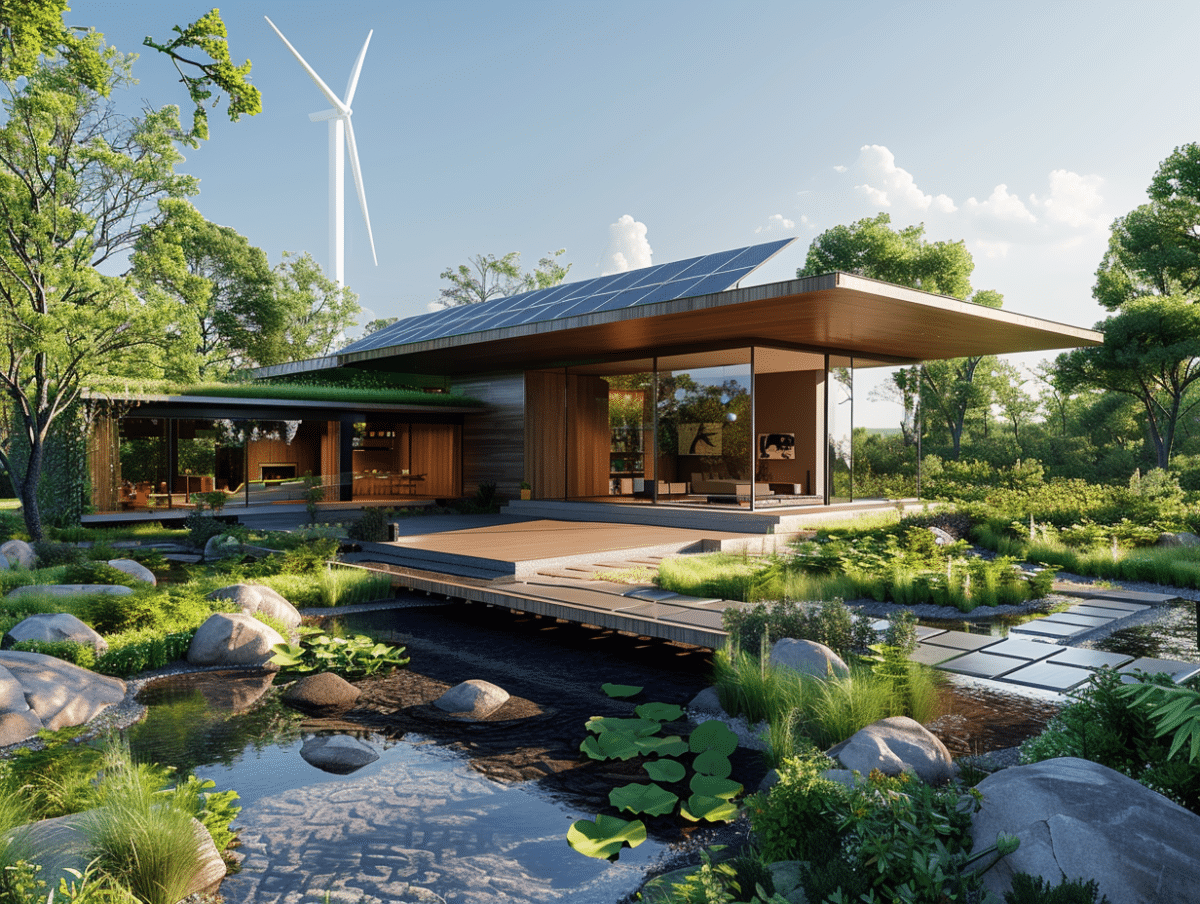
At a time when environmental preservation has become a major concern, housing is at the heart of discussions on sustainability. Individuals and communities are seeking solutions to reduce the ecological footprint of homes while managing costs. The transition to eco-friendly housing involves the adoption of innovative building materials, the use of renewable energies, and the implementation of energy-efficient consumption practices. These approaches aim to create healthy living spaces that respect the balance of our ecosystem while remaining economically accessible to a large part of the population.
Strategies for Sustainable Housing: From Design to Use
In the wake of ecological awareness, sustainable housing strategies are multiplying, adopting principles that are both ingenious and environmentally friendly. The tiny house, for example, with a surface area ranging from 10 m² to 45 m², meets a desire for minimalism and energy efficiency. Created by Jay Shafer and Grégory Johnson, this small mobile house built of wood on a trailer represents an alternative for those looking to reduce their ecological footprint without sacrificing mobility.
At the heart of community dynamics, participatory housing is developing as a self-managed housing model that combines private and communal spaces. This model, which resonates with the notion of co-ownership and shared living, prioritizes togetherness and mutual aid, while allowing for a more ecological management of resources. These collective housing projects are part of a sustainability and increased social responsibility approach.
At the same time, the autonomous house is emerging as a revolutionary concept, not connected to traditional networks, and which integrates photovoltaic and thermal solar panels for independent energy management. This independence prompts a reflection on the rational use of resources and encourages us to rethink our relationship with energy and self-sufficiency.
Let’s not forget more ambitious projects such as eco-villages and the forest city, planned in China, which aim to create autonomous ecosystems where humans and nature coexist in harmony. These concepts, although grandiose, highlight initiatives capable of profoundly transforming our living environments. Between innovations and revisited traditions, a cardboard house is no longer a utopia but a tangible reality, symbolizing the diversity and creativity of sustainable alternatives for an environmentally friendly habitat.

Cost Savings and Financing for Ecological Housing Projects
The construction of sustainable housing is often accompanied by the ambition to reduce energy consumption and carbon footprint. To this end, energy efficiency plays a prominent role in the design of these homes. Current standards, such as RT 2012 and the upcoming RT 2020, set thresholds for primary energy consumption that must not be exceeded: less than 50 kWh/m²/year for the BBC (Low Consumption Building) standard and less than 15 kWh/m²/year for the passive standard. Adopting these standards leads to a significant reduction in energy bills and contributes to achieving greenhouse gas emission reduction targets.
To support citizens in their efforts for ecological renovation, the State and certain financial institutions offer assistance programs: zero-interest loans, tax credits for certain energy renovation works, and grants dedicated to ecological materials. These incentive measures aim to alleviate the financial burden of transitioning to a more environmentally friendly habitat while promoting the growth of eco-construction.
Additionally, the Cittaslow movement, promoting a slower and more conscious pace of life in cities, encourages the use of local products and the integration of ecological criteria in urban planning. Cittaslow-certified municipalities, with a population of less than 50,000, are part of a global approach to eco-responsibility, thus contributing to a notable reduction in environmental impact.
In the context of sustainable development, the notion of grey energy also becomes an essential consideration. The energy required for the production, transport, and disposal of building materials represents a significant part of a building’s ecological footprint. In this regard, bio-sourced materials, such as natural wood, which have low grey energy (180 kWh/m³), prove to be wise choices for minimizing the overall impact of ecological constructions.