On a rainy Wednesday, an upcoming birthday party to host, or simply the desire to keep a group of 6-year-olds entertained without pulling out the credit card: the free printable treasure hunt checks all the boxes. At 6 years old, children can decipher simple words, recognize colors and shapes, and love solving riddles. These skills determine the type of puzzles and the route to prepare.
Puzzles suitable for 6-year-olds: what really works in the field
Before choosing a theme or setting, the fundamental question concerns the difficulty level of the clues. A 6-year-old reads short sentences but still struggles with abstract words. Purely textual puzzles quickly discourage them.
Have you ever seen a group of children lose interest after two minutes in front of a cluttered sheet? The problem rarely lies with the theme: it comes from the format of the clue. Three types of puzzles capture their attention without losing them:
- Illustrated rebuses, where each syllable is represented by a drawing (a cat + a pot = hat). The child associates image and sound, which engages reading without making it mandatory.
- Arrowed mazes that lead to a word or a place. The visual path maintains attention and gives a sense of quick progress.
- Color codes, where each color corresponds to a letter. The child colors or points to the right box to form the next clue word.
To find resources that combine these formats, the games offered by Famille XH provide directly printable kits with this type of visual puzzles tailored for 6-year-olds.
Mixing at least two clue formats in the same route prevents boredom. A rebus followed by a maze, then a color code: the variety reignites curiosity at each step.
Themes for free printable treasure hunts that captivate at 6 years old
The theme makes you want to play. Without a storyline, a series of puzzles feels like a school exercise. At 6 years old, the story takes precedence over the complexity of the challenges. A simple narrative thread is enough: a character has lost something, and the children must help.
Pirates and treasure map
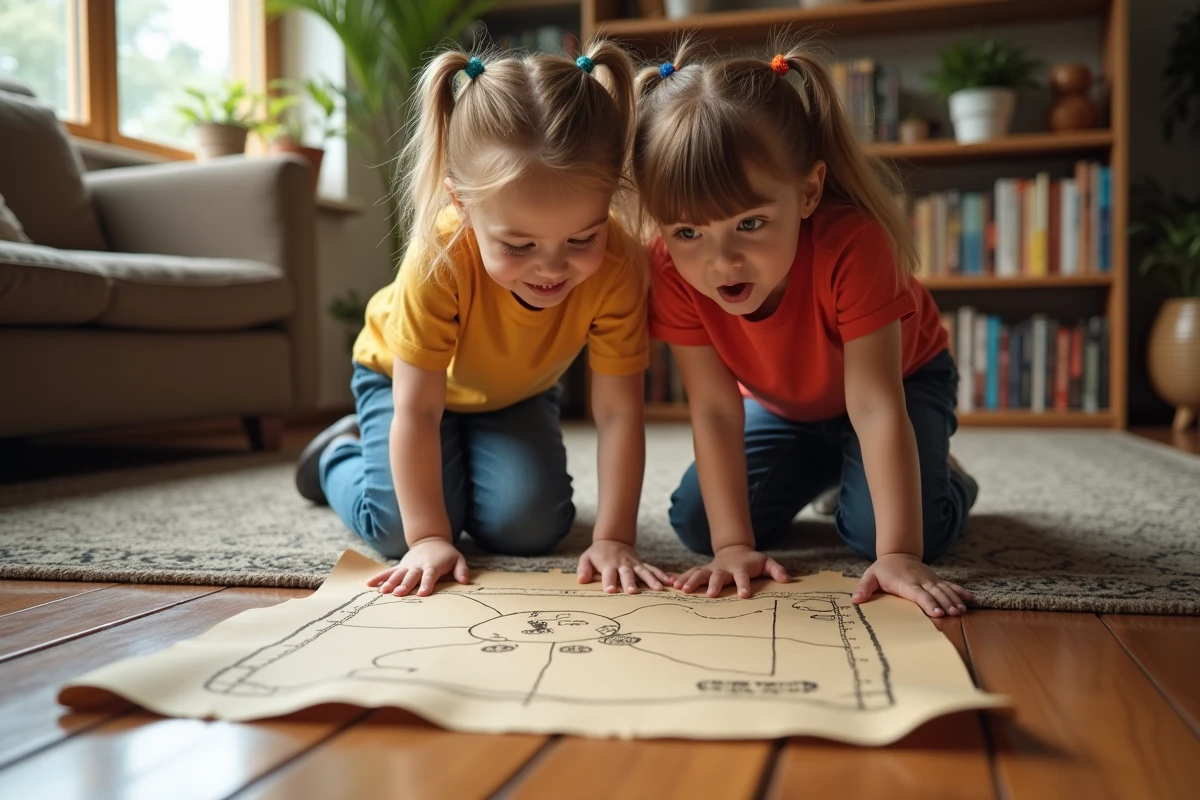
The classic still works. A hand-drawn map (or printed in black and white for the children to color), clues hidden in “islands” scattered throughout the house or garden. The treasure can be a cardboard chest filled with chocolate coins.
The strength of this theme: the children already know the universe. No need to explain the rules for long.
Animal investigation: who stole the hazelnut?
Less common in free kits, this scenario appeals to nature-curious children. Each clue leads to a suspect (the squirrel, the crow, the hedgehog), and players eliminate the culprits one by one using the clues. This investigation format develops reasoning by elimination, a skill that 6-year-olds are beginning to master.
Space and space mission
The children receive a “mission”: to find an energy crystal to repair their spaceship. Each room in the house becomes a planet. This theme lends itself well to puzzles based on color codes and symbols.
Clue routes indoors or outdoors: adapting the treasure hunt to your space
Why does this choice have such an impact on the success of the game? Because at 6 years old, the distance between two clues conditions the pace. Too far apart, the children disperse. Too close, the game loses its adventurous aspect.
Indoors, count on five to eight hiding spots spread across a maximum of two or three rooms. The kitchen, living room, and one bedroom are sufficient. Stick the clues at child height (under a chair, behind a cushion, in an accessible drawer).
Outdoors (garden, park), you can space the steps further apart. But plan a defined and visible perimeter. A fenced garden is ideal. For a public park, designate physical landmarks (the red bench, the big tree, the slide) rather than abstract directions like “go north.”
Five to eight steps represent the ideal duration to maintain the attention of a group of 6-year-olds, which is about thirty to forty-five minutes of play.
Free printable kits: accessible fonts and inclusive formats
One point that most sites do not detail: the choice of font changes the gaming experience. In recent years, several creators of free PDF kits have offered versions with fonts suitable for dyslexic children, such as Open Dyslexic.
These “dys-friendly” versions also use clues with a visual dominance (pictograms, arrows, color codes), making them accessible to all children in the group, not just those with reading difficulties.
Before printing, check these elements on the chosen kit:
- The font size is readable from an arm’s length (minimum body 16 once printed in A4).
- The instructions are formulated in sentences of fewer than ten words.
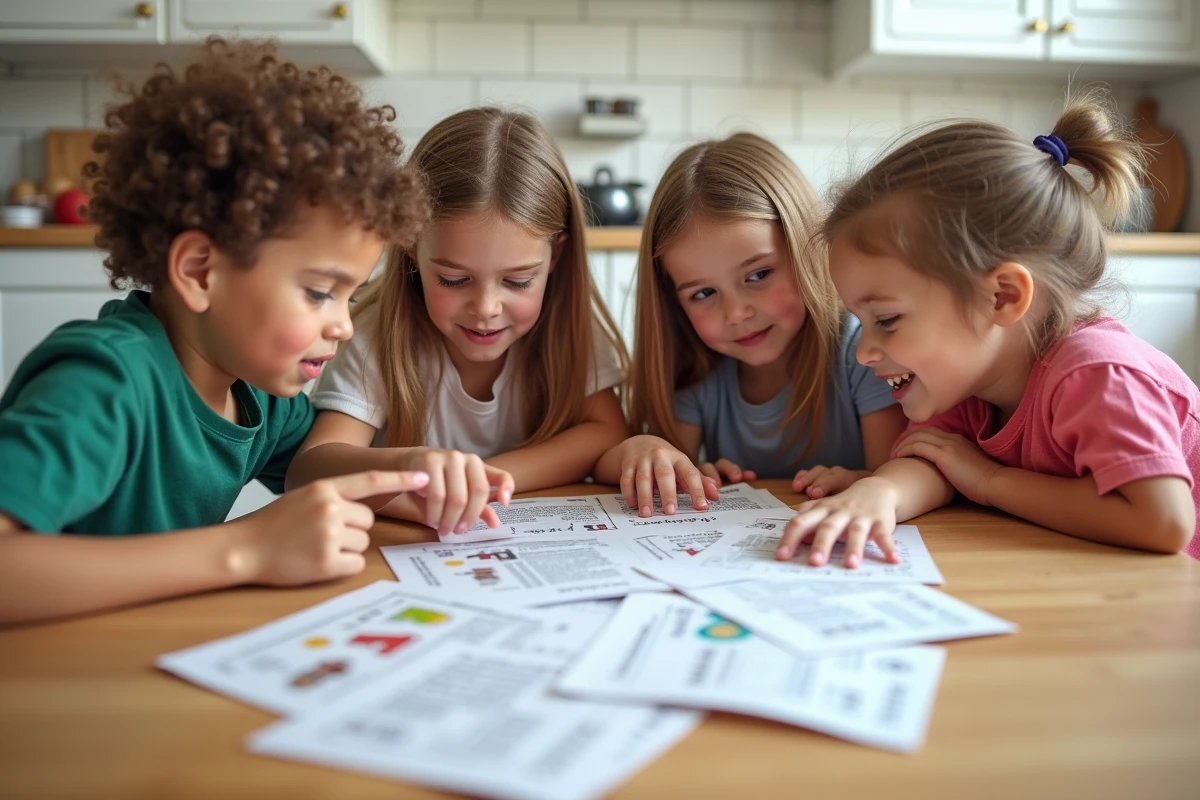
- Each clue includes at least one visual element (drawing, color, symbol) in addition to the text.
Also consider the paper weight. Paper that is too thin tears quickly in the hands of 6-year-olds, especially outdoors. A sufficiently dense weight (like drawing paper) withstands handling and moisture better.
One last detail that makes a difference: the creators of these kits remind us that free PDF files are not redistributable or resalable. You can print them as many times as necessary for personal use, but not share them in digital form on groups or forums. Respecting this rule ensures that authors continue to provide quality free content.